It's been a few years since Tesla first launched its electric cars to the public and it's needless to say that they have grown utterly popular over those years. Their most poplar seller, the Model S can be seen on the streets about every day in highly populated areas; not to mention, Tesla dealerships and stores are popping up in most suburb areas.
So I think it's safe to say that Tesla has obviously been playing their cards right with their popularity on the steady rise and innovative technology being shared all across the board. And with that comes a new model to their fleet. The Tesla Model X.
The Tesla Model X is a 7 seater crossover set to be released as a 2016 model to the public early on in the year. The vehicle was described as "a rolling tech showcase", and with the features the Model X provides, there is no doubt that this statement is true.
To start things off, the Tesla Model X is equipped with a 17" touchscreen control panel display that doubles as an entertainment system. Another cool attribute the Model X has is the falcon-wing doors which are double hinged and only uses as little as 12 inches to open up fully. The front doors have sensors that will automatically open and close the doors depending on where the key holder is located in the perimeter of the vehicle. The windshield of the Model X is the biggest piece of curved glass on an automobile.... ever! It gives the driver a nice panoramic view in all directions which allows for ultimate visibility.
The power train of the Model X is no joke either! Based off the same platform as the Model S, the new crossover tops out at 155 MPH and does 0-60 in 3.2 seconds. This all electric car will get you up to 250 miles until the battery starts to give out, and don't worry about about safety with this cross over. Tesla has this thing set up to reach a five star safety ratings in every field. The handling was just as we had suspected, damn near perfect for an SUV. The batteries are mounted in the floor allowing the crossover to obtain plenty of grip while giving very little body roll.
The new Model X is everything that you'd expect coming from Tesla and more. If you're interested in it's extreme luxury and outstanding performance, it will set you back with a starting price of $132,000. Is it worth it? We definitely think so!
This entry was posted in Automotive News on October 11, 2015 by XS Kyle.
Everyone knows the most noticed hybrid car on the road is the Toyota Prius. Yes, it does get a lot of hate from most car enthusiasts, but lets face it; it's safe, economical and extremely practical. Although it may be slow and boring to drive, you have to admit that the Prius was definitely ahead of its time.
Which brings us to now. The new 2016 Toyota Prius has made it's debut in Las Vegas just a couple days ago. And with that, it has been completely restyled with a futuristic look, once again going one step ahead of its competitors.
Let's talk about the design of the new Prius. First thing to note is the shape. As you can tell, the new Prius retains a similar "wedge" shape from the previous model, with some more aerodynamic accents along the sides of the chassis giving it an ultimate sleek look. The roof line has been lowered and the now common blacked out B and C pillars give the hood a sort of "floating" look. The front and rear of the car resemble the new Lexus vehicles with the boomerang style lights and hourglass shaped bumpers.
Now, we've heard a lot of hate about the new design, but let's take a step back and look at the other cool new features this car has to offer. To start things off, the new Prius is lighter and more aerodynamic even though the new model is actually larger in size. Which might explain the 10% increase with MPG efficiency. Another thing to note is that Toyota added a new Safety Sense System which includes: automatic high beams, pre-collision safety, and lane departure sensors.
We're excited to know more about this car, but we have to wait until the Los Angeles Auto Show in November, where Toyota will release the specs. to the public. What do you think about the new 2016 Prius? Love it or hate it?
Kyle @ XS
This entry was posted in Automotive News on September 11, 2015 by XS Kyle.
The Hyundai Sonata is upgraded and ready to go for 2015 and commentators say it has a lovely, smooth ride and a top of the line interior that positions close to the highest position of its class. With the best mix of positive surveys and overall costs in its class, the Hyundai Sonata is an undeniable bang for your buck. The Sonata additionally has the best blend of space, dependability, security features, and accessible family-accommodating elements. Let’s take a look at the major features of the 2015 Hyundai Sonata.
Driving Power
The 2015 Hyundai Sonata has intense speed that you can feel as soon as you put your foot on the gas. The base 2015 Sonata gets an EPA-evaluated 25mpg city and 37mpg highway, which is respectable for a reasonable midsize auto. Some car analysts think the Sonata offers an all-around generous driving offering with reliable power, great control, and made easy taking care of over long use. Most concur that it has magnificent braking force. In any case, others may have issues with its lack of punchy acceleration or sporty looks. This is quite frankly not the car for younger enthusiasts, if they are not interested in the accompanying features and build quality in which we are about to cover in-detail. With that said, the 2015 Hyundai Sonata is no slouch on modern amenities and luxury offerings.
Build and Comforts
The overhauled 2015 Hyundai Sonata's build materials are all the more top of the line, car enthusiasts say. They additionally welcome the Sonata's charming and simple interior. Commentators take note of the Sonata's trunk has 16.3 cubic feet of space, which is vast for the midsize class. Standard elements incorporate satellite radio, Bluetooth, and USB plug-and-play capabilities. Added features incorporate an all-encompassing sunroof, calfskin upholstery, warmed and ventilated front seats, warmed back seats, and Hyundai's Smart Trunk framework, which opens the storage compartment when it recognizes the keys behind the vehicle for over three seconds.
Other accessible components incorporate versatile cruise-controls (which can allow you to come to a full stop), a rearview camera, blind side checking, oncoming crash alerts, reverse parking/unparking alerts, a touch-screen display for various apps, games, and GPS. Screen is appealing and easy to understand, as indicated by car commentators. Test drivers like that a hefty portion of the Sonata's sound, atmosphere, and route controls are anything but difficult to utilize and kept separate from the touch-screen display.
2015 Sonata owners will have the capacity to plug their Android phones (running the most recent 5.0 "Candy" update) into their Hyundai's through the USB port. Upon first boot, clients are told to download the Android Auto app, which will utilize the phone's power to mirror a driver-tailored variant of Android's OS onto the in-dash touch screen.
Model Features
The Sonata Sport incorporates 17-inch compound wheels, an expertly-crafted bumper and grill, auto- headlights, a 5-inch in-dash touch screen, an 8-way controllable driver's seat, temp-control for the front seats, and chrome and carbon fiber elements all throughout the inside. In the event that purchasers choose to get the more effective 2.0L motor with the Sport trim they will likewise get 18-inch wheels in lieu of the 17-inch ones, HID Xenon headlights, aluminum pedals, a posh leather steering and seating upgrade, programmable atmosphere control, and vents for back seat travelers.
The Limited Trim truly ventures into elegance for the Hyundai Sonata. It comes standard with 17-inch composite wheels, a chrome front flame broil, LED tail lights, back window shades, a six-way controlled traveler seat to compliment the 8-way, controlled front seat for the driver, warmed back seats, real leather upholstery, wood grain accents, and an enhanced stereo that incorporates a subwoofer.
Upgrades
Some available extras to up the enjoyment of the Sonata is that purchasers can upgrade their car with elements ordinarily saved for the expensive luxury brands. Discretionary things on the Sonata incorporate an eleven-speaker Infinity premium sound framework, an 8-inch touch screen for the dash display, HD radio, an electronic stopping brake with vehicle lock, an upgraded cruise-control, temp-controlled steering wheel, vented and cooled front seats, ability to save settings for the drivers' seat and mirrors, and HID xenon headlights.
Hyundai says current buyers of route prepared 2015 Sonatas will have the capacity to redesign their autos to Android Auto with no charge—either via the dealership to download it today or from Android Auto on Hyundai's site later this year. Then, you would just need to transfer it to a USB and install.
Both Google and Apple guarantee far better accessibility of their cell phone controlled dashboard programming before the end of 2015, with numerous automakers vowing to bolster both working OS’. In a perfect world, this implies that your next new-auto buy could get no matter which cell phone you favor.
Doing burnouts and muscle cars go together probably better than anything else for car junkies like us. Word on the street is that the new 2015 Mustang GT is going to come standard with a feature that makes doing burnouts a lot easier. This feature is called the “electronic line-lock” and was developed for drag racers to warm up their rear tires before their run. This system uses a hydraulic lock on only the front brakes allowing the driver to freely spin the rear tires with out having to keep their foot balanced on the brake pedal.
The electronic line-lock is combined with other features as well, such as launch control and allows other modes of driving such as: snow/wet, normal, sport and track. These new driving modes are designed to give peak performance in each given scenario and is all displayed electronically on the dash. This system can also be turned off incase you want to have some fun the old fashioned way. It’s technology like this that makes the 2015 Mustang the most advanced ever.
So far, Ford is the only car maker that offers this feature standard. Their vision when creating this technology was to make it so weekend racers can use their car as a daily driver but still able to have some fun on track without having to modify their car’s brake system. But don’t get too excited everyone, Ford claims that this system is to only be used for intended track use and that any racing will void the cars warranty.
We have HID Xenon Headlight Upgrades for Ford Mustangs of all years including the 2015 Ford Mustang via the link below!
Many suppliers of HID Conversion Kits claim to carry the best ballasts on the market. Here at XenonSupply.com, we actually do! The reason our Premium ballasts are superior is because of the chipset we use. Our XenonSupply.com Premium ballasts use a DSP chipset. DSP stands for digital signal processor.
What does a DSP do? A DSP takes a digital signal and processes it to improve the signal. The improvement may be clearer sound, sharper images, or faster data.
DSP chips are used in variety of different products but can be found in guitar effect pedals, calculators, telecommunication systems, audio and video recording and playback, MP3 players, cell phones, sound cards, fax machines, digital TV’s, rockets, missiles, and spacecraft.
Most HID suppliers use ballasts with a MCU chipset. MCU stands for microcontroller. These MCU’s are easy to copy and allow almost any engineer the ability to create ballasts in his living room. The DSP chipset is more complex and a newer technology.
HID Conversion Kit Ballasts do not like variations in power output to the bulb because it changes the running temperature and puts stress on the two electrodes wearing them down faster. DSP chips clean & filter all the fluctuations in power before converting the DC power to AC giving components a better chance of living its true lifespan.
Advantages of using XenonSupply.com Premium Ballasts with a DSP chipset:
(1) Operates at high-speeds. Can complete analog signal processing and implement relevant directives quickly.
(2) Can implement tens of millions of complex instructions in seconds and be able to accurately identify every signal.
(3) The high-speed precision computational capability has realized the power factor compensation function; making sure the light source emits stable, flicker-free, comfortable and bright lighting to ensure the safe driving.
(4) DSP chips high-speed signal processing capability protects hundreds of components in XenonSupply.com Premium ballasts ensuring high efficiency and a long service life of the ballast.
To Purchase Premium Ballasts, HID Bulbs, or a HID Conversion Kit, visit www.xenonsupply.com!
- XS Team
This entry was posted in Tech Blog on April 25, 2014 by XS Tech.
Which bulb color do I choose for my XenonSupply.com HID Conversion Kit? Let’s start by explaining what the “K” means. The ‘K’ is an abbreviation for KELVIN, which is a temperature scale. A higher “K” value results in more color. A lower “K” value results in more useable light.
The most popular HID Bulb color at XenonSupply.com is 6000K because customers prefer an ice-white finish with a hint of blue. We never recommend a bulb color higher than 8000K for street use, as these bulbs are very dark and hinder visibility. A color temperature above 8000K should only be used for show cars and off-road use. The higher the color temperature, the darker the color produced.
Characteristics of various surfaces cause them to reflect or absorb certain wavelengths. The colors that are reflected to our eyes are what determine the colors we see. The term "reflection" is derived from the Latin term reflectere -- meaning "to bend back.” When light hits an object it can either be reflected or refracted. Refracted light continue to travel through the object at a different angle than when it hit the object. Reflected light bounces off an object at the same angle with which it hit the object. Usually, when light hits an object, a little bit of reflection and refraction happens. For example; if a bulb is blue, it reflects blue light and absorbs the other colors which is why it appears blue. White light is composed of all possible wavelengths of visible light, so it reflects off all objects and provides the best visibility. White surfaces are composed of molecules or atoms that don’t absorb any of the visible colors of light; our eyes perceive this reflected combination as the color white.
The 4300K color temperature provides the best visibility, which is why it is the OEM on most vehicles. Visibility is a measure of the distance at which an object or light can be clearly discerned. Color temperatures above 8000K provide poor visibility because they offer less useable light.
The visible light spectrum is the section of the electromagnetic radiation spectrum that is visible to the human eye. It ranges in wavelength from approximately 400 nm (4 x 10⁻⁷ m) to 700 nm (7 x 10⁻⁷ m). It is also known as the optical spectrum of light.
If you have any additional questions regarding XenonSupply.com HID bulb colors for your vehicle please email us at help@xenonsupply.com or call us toll-free at 1-800-840-3240.
Cheers, Larry and XS Team
This entry was posted in Miscellaneous on July 11, 2013 by XS Tech.
High-intensity discharge lamps (HID lamps) are a type oflamp which produces light by means of an electric arc between 2 rare earth metal rods that are housed inside a special quartz tube. The chamber in the center of the tube is filled with a special gas and metal salts. This is where the electric arc takes place. Once the arc is started, it heats and evaporates the metal salts forming an ionized gas called plasma. This greatly increases the intensity of light produced by the arc and reduces its power consumption. The quartz tube blocks out harmful UV rays and protects the lifespan of the lamp.
How do they compare to other bulb technologies? HID lamps produce much more light and much less heat than halogen, LEDs, fluorescent bulbs andhouse hold light bulbs.
HID - The brightest technology (3200 Lumens), lowest heat output, comes in Yellow(3000k), OEM White(4300k), Crystal White(6000k), Light Blue(8000k), Blue(30,000k), Purple(35,000k) LED - Not as bright as HID, lower heat output than halogen, comes in Crystal White(6000k), Light Blue(8000k), Ruby Red,Emerald Green, Dark Blue Halogen - Not as bright as HID (1400 Lumens), has a yellow tint, produces more heat than light Flouresent - Not as bright as halogen (1000 Lumens), produces more heat than light Household - Not as bright as flouresent (500 Lumens), has a yellow tint, produces more heat than light
Why are there only HID kits for low beams and fogs but not high beams? When initially turning on your HIDs, they can take 10 to 15 seconds to fully warm up. High beams need to be able to turn on and off very fast. If HIDs were installed for high beams, they would not be able to properly perform this function.
Some vehicles have a single bulb that preforms both functions of low beam and high beam (Bi-Xenon). This is perfectly okay because the HID bulb heats up from the initial start up in low beam position. In order for the bulb to change from low to high it uses a solenoid to change the bulb position which changes the angle of light, which means continuous light output with no disruption in light output, just a change in angle.
What else is HID technology used for? HIDs can be found in more than just the headlights of a vehicle. They can be found in theaters, projectors, projector TVs, flood lights, police and military spotlights, air crafts, and many types of recreational buildings. HID is the most preferred technology because of its immense light output, clean colorless light, durable structure, and lengthy life span.
This entry was posted in Tech Blog on February 4, 2013 by XS Tech.
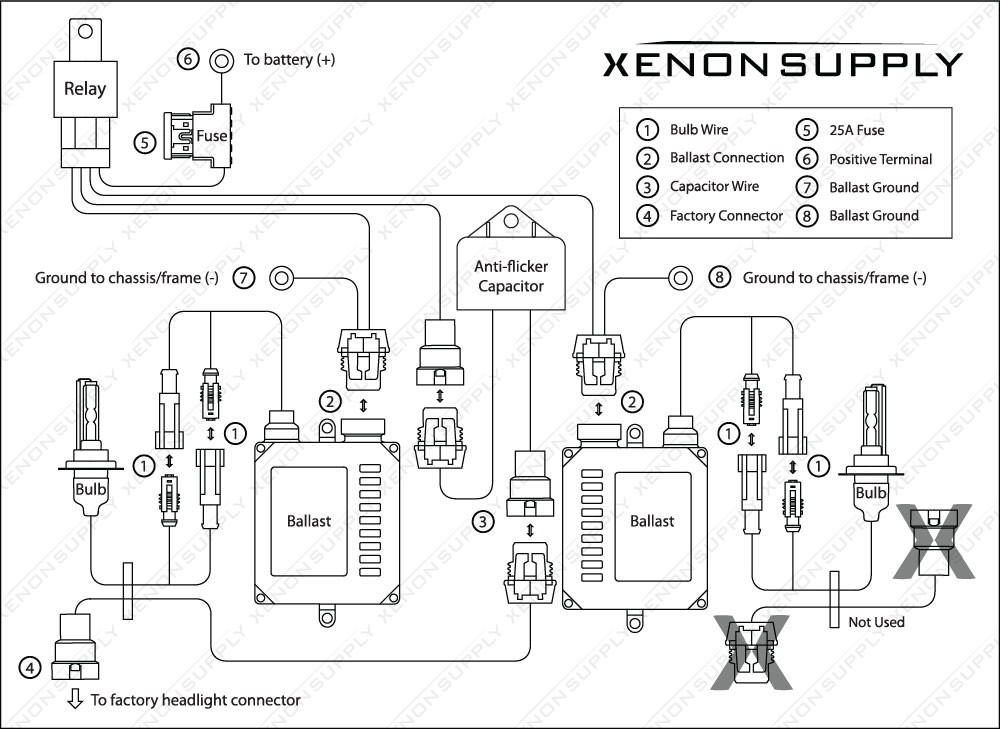
A Wiring Harnesses primary function is to provide power directly from the vehicles battery to the HID system. This allows an HID system to operate independently of the vehicles electrical system and provides a more constant power source.
Whats in an Accessory Wiring Harness?
An Accessory Wiring Harness is also referred to as a Relay Wiring Harness as it utilizes a simple automotive relay in its design. A Wiring Harness utilizes a 30amp fuse protected power wire that directly connects to your positive terminal on the battery. An Automotive Relay is used to pull signal from a source (Headlight connector) that triggers power to be drawn from the battery. There are two sets of cables meant to provide power to an HID ballast. There are also two separate ground wire terminals that need to be connected to the chassis to complete the electrical circuit.
What does a Wiring Harness fix?
An Accessory Wiring Harness is capable of fixing a variety of power related HID lighting issues i.e. intermittent on/off, flickering, delayed start, HID low light output, and uneven brightness.
Problem: Delayed Start An HID Ballast requires more power to ignite on startup than during normal usage. This initial power surge can sometimes be problematic for vehicles with weaker electrical systems that cannot provide the power needed. The vehicles stock headlight connectors are not capable of providing 7-8 amps per headlight and as a result, only one HID turns on when the switch is turned on. After about 20 seconds when the ballasts power consumption drops to 3.2 amps, you can quickly turn the lights off then back on and voila, both HID lights turn on. This scenario happens all the time and is the direct result of insufficient power.
Solution:
An HID wiring harness with power supplied directly from the battery would eliminate this issue as it would be able to consume up to 30 amps through the batteries positive terminal to ignite both ballasts.
Problem: Flickering An HID Ballast that is not getting sufficient power from a stock headlight connector will cycle on and off as it tries to ignite and power on. This can also be a result of an inefficient ballast that is not able to convert the available power to properly ignite an HID system.
Solution: An HID wiring harness will provide the power necessary to ignite even an inefficient ballast for flicker free HID lighting.
Problem: Dim/Dark Light Output: When a ballast is underperforming, light output can appear more blue and dimmer than it should be. This is a result of the ballast not converting enough power to ignite the bulb at its optimal range. A bulb that is 4300K connected to a ballast with a weak power source, can look like an 8000K blue color with substantially lower light output.
Solution: An HID Wiring harness will be able to provide more power to the ballast allowing the system to operate at 100%. This however is not a guaranteed solution as a poor quality ballast will not output sufficient power no matter how much is being inputted.
Problem: Uneven Brightness My passenger side is brighter than my driver side! Power in not always delivered in equal amounts to each headlight, and depending on your vehicles wiring configuration, can have a negative impact on lighting performance when installing HIDs. If one headlight has less resistance to the power source i.e. less bends or curves in the wiring, length of wiring, fuse panels bridging connections etc, it will receive power first leaving less for the second headlight to consume. In this scenario, one headlight will end up brighter than the other.
Solution: An HID wiring harness will provide equal amounts of power to each HID Ballast allowing for even and consistent brightness between both headlights.
To Buy or Not to Buy? An HID wiring harness for some vehicles is a safety and assurance item to prevent future problems, and for other vehicles is a necessary requirement to a successful HID installation. We here at XenonSupply do our best to bundle packages together based on our research to make sure you have all the components necessary for a issue free installation. Our general recommendation is to always use a harness where possible to help extend the life of your HID system. Not only are you providing your HID ballasts with adequate power, you are protecting both your vehicle and HID system with the inline fuse that separates the systems.
When upgrading to HIDs and researching how to go about installing your kit, you'll often come across many debates about projector housings and reflector housings and how they affect an HID upgrade. There are a few dominant opinions about this topic on the internet that are both conflicting and incorrect. Let's dispel the myths, get the facts straight, and help you determine how best to improve your vehicle lighting experience.
Biggest Myth: "Reflector housings are not made for HIDs"
Unfortunately, for all the naysayers out there, this is not a true statement. When HIDs were first introduced to the car market in the late 90's, they all came in a reflector housing. Case in point, the 2001-2003 Acura CL, 2001-2003 Lexus IS, GS, and LS series. Each of these vehicles used a D1/D2 series HID bulb in a reflector housing that controlled light output. These housings were designed with HID light output in mind and were designed with "glare caps" placed over the bulbs to control how light was emitted. Today, many manufacturers have adopted this type of "Glare Cap" for their own halogen housings, making them comparable to the above mentioned vehicles when converted to HID. The basis of the myth that reflector housings were never meant to be used with HIDs stems from the improper installation of HID kits in older vehicles that do not control light well and are not capable of minimizing glare from the additional light to oncoming traffic. This is not to say that all reflectors work well with HIDs; that would also be a false statement. Some reflectors work better than others and you just don't know how it will perform until you try.
How exactly does a Reflector work vs a Projector Lens based headlight system?
Reflector: From the light source, light bounces off the rounded surface of the reflector housing and is directed outward focusing light in one direction. As you can see from the photo below, light is distributed in many different angles in the manner as a halogen flashlight. This method, although adequate, involves a lot of wasted light as not every beam is directed properly and can angle off too far up or down which is not visible to the driver.
Projector: From the light source, light bounces inside an elliptical housing before escaping to a concave lens that straightens out the light path directing each beam in the same uniform direction. This provides better lighting because light output is more tightly controlled and all light is directed through the concave lens. You will also notice a shield in a projector lens that blocks light from illuminating the top half of the light pattern. This blocking of light is most commonly known as the light cut-off and is responsible for the sharp beam pattern associated with HID lighting. A projector lens wastes less of the light source and provides more beams of light pointing in the right direction over reflector based lighting.
Traditional Reflector Housing Light Path
Projector Housing Light Path
How does this affect HID lighting?
The light output of an HID system in a reflector based housing is entirely dependent on the design and manufacture as each housing uses different angles and shapes to achieve optimal light output. This is because the size of the reflector housing typically changes to match the profile of the vehicle. With new vehicles on the road today, reflector housings actually control light with both halogen bulbs as well as HID bulbs extremely well with the inclusion of what's known as an Anti-Glare Cap, that limits light output and cuts down on stray light patterns. See the below photo to see an example of the Anti-Glare Cap, and light output of an HID system in a reflector housing + Anti-Glare Cap.
Headlight Housing With and Without Anti-Glare Cap
2011 Hyundai Elantra HID Output using a Halogen Based Reflector Headlamp With Stock Anti-Glare Cap
In terms of lighting performance, the HID system installed into the Halogen based Reflector housing is very good. There is little to no excessive light above the main beam pattern and light is distributed evenly. The 2011 Hyundai Elantra in particular is quite receptive to an HID lighting upgrade and its improvement in lighting is fantastic over halogen.
In comparison, the below photo shows the light output as well as light pattern control of a Projector Lens based system. Notice the further improvement in light distribution and the sharp cutoff at the top of the light pattern to control glare. This is taken from a 2011 Hyundai Sonata that came with stock Halogen Projector Lens upgraded with XenonSupply HIDs.
Simply put, HIDs installed in reflector housings must be judged on a per vehicle basis as the lighting performance varies depending on make, model, and year. In general terms, newer vehicles whether they are economy cars or luxury cars, will accept an HID upgrade much better than, say, a 1990 Honda Civic. Systems with Anti-Glare Caps already installed by the manufacturer do exceptionally well with HID lighting by controlling light output and limiting glare. Projector lens based headlight housings will always perform better than reflector based systems because of their use of the concave lens and elliptical reflector cup.
I hope you all enjoyed this brief overview and as always, if you have additional questions please let us know. Our support staff can always be reached at Help@XenonSupply.com to answer your technical questions.
Cheers
Phil and XS Team
This entry was posted in Tech Blog on September 25, 2012 by XS Tech.
Bi-Xenon HID What!? A complete guide to Dual Filament Halogen Bulbs and Bi-Xenon HID Conversions
When it comes to converting halogen headlights to Xenon HID systems, nothing is more confusing than the Bi-Xenon HID Conversion. The idea is not difficult to understand, but there is a lack of information available on the net explaining the bulb information in detail.
A Dual Filament bulb is nothing but a halogen bulb with two lighting filaments side by side (see fig 1.1). When your low beam light is turned on, the light produced by the top filament reflects at a specific angle only illuminating the lower light path. The high beam filament, because of its alternate position, reflects at a higher angle producing the high beam light path. This allows the vehicle manufacturer to reduce the cost of making a headlight, by combining both low beam and high beam, traditionally in separate housings, into one with a single bulb (dual filament bulb that is).
In order to convert this type of halogen bulb to HID, you must first understand Dual Filament Halogen Bulbs. This should be simple considering there are only three types...right?
If your vehicle uses these types of bulbs, this information applies to you.
H4 (Also known as 9003,HB2) 9007 (Also known as 9004) H13 (Also known as 9008)
Why so many names? H4, 9007, and H13 are the most up-to-date versions of these bulb types, whereas the other bulb names are their previous generations. Generational differences include changes in manufacturing standards, different materials used to produce the bulbs, improvements in optics/design, etc.
Each of these bulb types have four potential HID conversion bulb types. Let's take the H4 bulb type, for example, and explain the four options.
H4-1 (Xenon Single Beam H4)
This is the most simple of HID conversions, and also the most limiting. This will upgrade only your low beam light to HID, leaving the high beam disabled. This is also the cheapest and most common replacement HID bulb for an H4 Dual Filament bulb and also the worst one to select. Not only do you lose high beam, you will likely have high beam warning lights on your dash as there are no wires running to your high beam circuit.
H4-2 (Xenon Low Beam, Halogen High Beam)
This bulb should only be used in specific situations once you understand how it works. This bulb adds a halogen bulb off center of the xenon low beam bulb in order to satisfy the high beam requirement. High Beam light output of this smaller bulb is severely inadequate and should only be used to satisfy state and local vehicle safety inspections. This is not a true Bi-Xenon HID system.
H4-3 (Switching High/Low)
This is a true Bi-Xenon HID system. The -3 variant uses an electromagnet to change the physical position of the HID bulb for the low beam as well as high beam. This moving bulb adjusts the focal length and adjusts light output to a wide angle for high beam, and a tighter more focused light for low beam. XenonSupply highly recommends the use of this type of Bi-Xenon bulb wherever possible and is the only Bi-Xenon bulb type sold and guaranteed to work.
H4-4 (Xenon High Xenon Low)
This is the most expensive of HID Bi-Xenon bulb types and has largely been phased out due to its extremely high costs and unpopularity among users. Two independent HID bulbs are placed side by side to produce the low beam and high beam light. The problem with this design is that each bulb needs its own independent ballast. In order to fully convert your low beam and high beam to HID with this type of kit, you need four HID ballasts, and wiring harnesses to ensure proper ignition to the HID system.
XenonSupply has always recommended and supported the -3 Bi-Xenon bulb type and uses an industry leading reconfigurable wiring harness for easy installation as well as troubleshooting with these systems. Each HID kit or Pair of Bi-Xenon Bulbs sold come with an included reconfigurable wiring harness with quick disconnect connections. The reason for its reconfigurability is because not all vehicles are wired the same and each bulb type has its own wiring schematic. With a XenonSupply made harness, you will be able to easily troubleshoot HID issues if any.
To check out what Bi-Xenon HID kits XenonSupply has to offer, hit the links below for more info.
If you purchased an HID kit from somewhere else and now you need a reconfigurable wiring harness for your -3 style HID bulbs, don't panic! Our harness can be used with other HID kits as long as the connectors are compatible. Check out the link for more details on our selection of Bi-Xenon Wiring Harnesses
As always, if you have questions regarding this article, or need help finding the right HID kit for your vehicle, let us know at Help@XenonSupply.com, or give us a call toll free at 1-800-840-3240.
Cheers,
Phil @ XS
This entry was posted in Tech Blog on June 15, 2012 by XS Tech.



 DSP chips are used in variety of different products but can be found in guitar effect pedals, calculators, telecommunication systems, audio and video recording and playback, MP3 players, cell phones, sound cards, fax machines, digital TV’s, rockets, missiles, and spacecraft.


 Unfortunately, for all the naysayers out there, this is not a true statement. When HIDs were first introduced to the car market in the late 90's, they all came in a reflector housing. Case in point, the 2001-2003 Acura CL, 2001-2003 Lexus IS, GS, and LS series. Each of these vehicles used a D1/D2 series HID bulb in a reflector housing that controlled light output. These housings were designed with HID light output in mind and were designed with "glare caps" placed over the bulbs to control how light was emitted. Today, many manufacturers have adopted this type of "Glare Cap" for their own halogen housings, making them comparable to the above mentioned vehicles when converted to HID. The basis of the myth that reflector housings were never meant to be used with HIDs stems from the improper installation of HID kits in older vehicles that do not control light well and are not capable of minimizing glare from the additional light to oncoming traffic. This is not to say that all reflectors work well with HIDs; that would also be a false statement. Some reflectors work better than others and you just don't know how it will perform until you try.


